Showing posts with label asia. Show all posts

Tuesday, 14 July 2020

South China Sea dispute: China's pursuit of resources 'unlawful', says US


The US has previously accused China of militarising the South China Sea

China's pursuit of offshore resources in parts of the South China Sea is "completely unlawful", US Secretary of State Mike Pompeo has said.

Mr Pompeo said he wanted to make clear that Beijing's "campaign of bullying to control" the disputed waters was wrong.

China said that the US "deliberately distorts facts and international law".

China has been building military bases on artificial islands in the region also claimed by Brunei, Malaysia, the Philippines, Taiwan and Vietnam.

The countries have wrangled over territory in the South China Sea for centuries, but tension has steadily increased in recent years.

Beijing claims an area known as the "nine-dash line" and has backed its claim with island-building and patrols, expanding its military presence there.

Why is the South China Sea contentious?

Although largely uninhabited, two island chains in the area may have reserves of natural resources around them. The sea is also a shipping route and has major fishing grounds.

In its annual defence review, Japan said China's naval activities are a matter of grave concern, accusing Beijing of attempting to alter the status quo in the East and South China Seas.

What did Mr Pompeo say?

In a statement on Monday, Mr Pompeo denounced China's claims on the disputed Spratly Islands in the South China Sea, saying Beijing had "no legal grounds to unilaterally impose its will on the region".

He said the US, which has previously said it does not take sides in territorial disputes, rejected Beijing's claims to waters off Vietnam, Malaysia and Indonesia.

"Any [People's Republic of China] action to harass other states' fishing or hydrocarbon development in these waters - or to carry out such activities unilaterally - is unlawful," he said.

"The world will not allow Beijing to treat the South China Sea as its maritime empire."

How did China respond?

In a statement posted on Twitter, the Chinese embassy in Washington DC said the US state department "deliberately distorts the facts and international law including the United Nations Convention on the Law of the Sea".

It said America "exaggerates the situation in the region and attempts to sow discord between China and other littoral countries.

"The accusation is completely unjustified. The Chinese side is firmly opposed to it."

Significant risks with seemingly insignificant islands

Zhaoyin Feng, Chinese, Washington DC

Before now, the US had not taken sides on territorial disputes in the South China Sea.

Four years after an international tribunal in The Hague ruled that China's claims in the region have no legal basis, the US has for the first time officially made its stance clear. But why now?

Last week, China and the US held naval exercises in the area at the same time - a rare phenomenon indicating rising tensions.

In the bigger context, the Trump administration has pledged to overturn what it says is 40 years of policy failure with regard to China. Washington has recently criticised Beijing on issues ranging from its handling of the coronavirus pandemic, to human rights violations against Muslim minorities in Xinjiang and how it has dealt with pro-democracy protests in Hong Kong.

But it was China's land reclamation projects in the South China Sea that prompted the rest of the world to reassess Beijing's international ambitions.

And the stakes in the region are incredibly high. In these seemingly insignificant island chains and reefs, there are growing risks of military conflict between the world's two most powerful countries.

Mr Pompeo said the US stood "with our South-East Asian allies and partners in protecting their sovereign rights to offshore resources," adding that this position was "consistent with their rights and obligations under international law".

What's behind the South China Sea dispute?

The sea, home to vital shipping lanes, has in recent years become a flashpoint for tensions between China and other nations which claim sovereignty over two largely uninhabited island chains, the Paracels and the Spratlys.

China claims the largest portion of territory, saying its rights go back centuries. The area is rich for fishing and is thought to have abundant oil and gas reserves.

The US has long been critical of what it says is China's militarisation of the region and routinely angers Beijing with "freedom of navigation" missions.

In August 2018, a BBC team flew over the disputed South China Sea islands in a US military plane. In a radio communication, the pilots were warned to leave the area "immediately" in order to "avoid any misunderstanding".

Tuesday, 7 July 2020

The United States is 'looking at' banning TikTok and other Chinese social media apps, Pompeo says

TikTok

Hong Kong/Washington (CNN Business) The United States is "looking at" banning Chinese social media apps, including TikTok, Secretary of State Mike Pompeo said Monday.

Pompeo suggested the possible move during an interview with Fox News' Laura Ingraham, adding that "we're taking this very seriously."

Pompeo was asked by Ingraham whether the United States should be considering a ban on Chinese social media apps, "especially TikTok."

"With respect to Chinese apps on people's cell phones, I can assure you the United States will get this one right too, Laura," he said. "I don't want to get out in front of the President [Donald Trump], but it's something we're looking at."

Washington's top diplomat added that people should only download the app "if you want your private information in the hands of the Chinese Communist Party."

TikTok did not immediately respond to a request from CNN Business for comment.

Pompeo's remarks come during a time of heightened tensions between the United States and China, which have spilled over into several arenas including national security, trade and technology.

TikTok — which is owned by Beijing-based startup Byte Dance — has been repeatedly criticized by US politicians who accused the short-form video app of being a threat to national security because of its ties to China. They allege that the company could be compelled to "support and cooperate with intelligence work controlled by the Chinese Communist Party."

TikTok has said previously that it operates separately from Byte Dance. It says its data centers are located entirely outside of China, and that none of that data is subject to Chinese law. US user data is stored in the United States, with a backup in Singapore, according to TikTok. A spokesperson for the company told CNN Business in May that it thinks the national security concerns are "unfounded."

TikTok has exploded in popularity in the United States and other western countries, becoming the first Chinese social media platform to gain significant traction with users outside of its home country. It was downloaded 315 million times in the first three months of this year, more quarterly downloads than any other app in history, according to analytics company Sensor Tower.

This is a developing story and will be updated. Sherisse Pham contributed reporting.

Thursday, 2 July 2020

Hong Kong: US passes sanctions as nations condemn new law


Protesters rallied against the new law in Hong Kong and police made several hundred arrests

The US House of Representatives has approved new Hong Kong-related sanctions, after Beijing imposed a security law that was condemned by countries around the world.

The measure, which was passed unanimously, penalises banks that do business with Chinese officials.

It will have to be approved by the Senate before going to President Trump.

Critics say China's law ends freedoms that were guaranteed for 50 years when British rule ended in 1997.

"The law is a brutal, sweeping crackdown against the people of Hong Kong, intended to destroy the freedoms they were promised," said House Speaker Nancy Pelosi.

UK Prime Minister Boris Johnson said the passing of the law was a "clear and serious breach" of the 1985 Sino-British joint declaration.

  • Why people are scared of Hong Kong's new law

Under this declaration, Hong Kong was handed back to China in 1997, with certain freedoms guaranteed for at least 50 years under the "one country, two systems" agreement.

The UK has offered residency, and then citizenship, to up to three million Hong Kongers.

But on Thursday China threatened "corresponding measures" to block the citizenship plan.

"If the British side makes unilateral changes to the relevant practice, it will breach its own position and pledges, as well as international law and basic norms," said the Chinese Embassy in the UK.

Meanwhile, a 24-year-old man from Hong Kong - suspected of stabbing a police officer during Wednesday's protests - has been arrested on a plane while trying to flee to London.

The suspect, known only as Mr Wong, was detained on the plane moments before it set off.

  • UK asylum for ex-consulate worker 'tortured in China'

China said the security law was necessary to stop the type of protests seen in Hong Kong during much of 2019.

And despite condemnation in the West, more than 50 countries, led by Cuba, supported China at the UN this week.


What does the US law say?

The Hong Kong Autonomy Act imposes sanctions on banks that do business with Chinese officials who are involved in cracking down on pro-democracy protesters in Hong Kong.

Ms Pelosi said the law was an "urgently needed response to [China's passing] of its so-called 'national security' law... which is purpose built to dismantle democratic freedoms in Hong Kong".

  • What if the US removes Hong Kong's special status?
  • US imposes visa restrictions on Chinese officials

Before the bill was signed, the US had already began eliminating Hong Kong's special status - halting defence exports and restricting the territory's access to high-technology products.

Last year, the US had also signed into law the Human Rights and Democracy Act, supporting pro-democracy protesters in Hong Kong.

What have other countries said?

The UK said it will offer up to three million Hong Kong residents the chance to settle there and ultimately apply for full British citizenship.

Australia is also "actively considering" offering safe haven to Hong Kong residents - with Prime Minister Scott Morrison saying there were proposals that will "soon be considered by cabinet".

Japan was among the other countries that spoke out against the law, calling it "regrettable".

"It will undermine trust for the principle of 'one country, two systems'" said Foreign Minister Toshimitsu Motegi.

European Council President Charles Michel said it "deplored" the law - adding that it had a "detrimental effect on the independence of the judiciary and rule of law".

And Canada changed its travel advice to Hong Kong, saying the new law "increased the risk of arbitrary detention on national security grounds and possible extradition to mainland China".

Yesterday, a senior Chinese official slammed foreign critics, saying Hong Kong's affairs were "none of your business".

Have all countries been critical?

No. At the United Nations this week, Cuba - on behalf of 53 countries - welcomed the law.

Speaking at the 44th session of the United Nations Human Rights Council, it said: "Non-interference in internal affairs of sovereign states is an essential principle enshrined in the Charter of the United Nations.

"We believe every country has the right to safeguard its national security through legislation, and commend relevant steps taken for this purpose."

Wednesday, 1 July 2020

Hong Kong: 'Anti-protest' law kicks in as city marks handover


Small protests took place on Wednesday morning

Hong Kong is marking 23 years since British rule ended as a new "anti-protest" law, imposed by Beijing, comes into effect. 

The national security law targets secession, subversion and terrorism with punishments up to life in prison.

Hong Kong was handed back to China from Britain in 1997, under an agreement supposed to protect certain freedoms for at least 50 years.

But critics say the law is the "end of Hong Kong", and stops those freedoms.

"[China] promised 50 years of freedom to the Hong Kong people, and gave them only 23," US Secretary of State Mike Pompeo said.

China's new law: Why is Hong Kong worried?

The city's leader, however, said the law would "restore stability" after widespread protests in 2019.

"The [new law] is considered the most important development in relations between the central government and Hong Kong since the handover," said Chief Executive Carrie Lam.

At the same time, a Chinese official bristled at foreign critics, asking them: "What's this got to do with you?"

"We Chinese will not be scared by anyone," said Zhang Xiaming of the Hong Kong and Macao Affairs office of the State Council. "Gone are the days when we had to take cues from others."

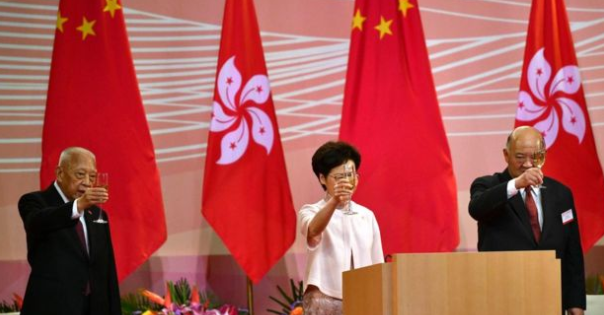
Hong Kong Chief Executive Carrie Lam (centre) said the new law was long overdue

Will there be mass protests on the anniversary?

A pro-democracy protest is held each year on the anniversary, typically attended by tens or hundreds of thousands of people.

But for the first time since the handover, authorities banned the march - citing a ban on gatherings of more than 50 people because of coronavirus.

Some activists have pledged to defy the ban and march later in the afternoon.

"We march every year... and we will keep on marching," pro-democracy activist Leung Kwok-hung told Reuters.

Photos on social media - confirmed by police as genuine - showed a flag being used to warn protesters about the new law.

police warning

One pro-democracy activist warned there was a "large chance of our being arrested".

"The charges will not be light, please judge for yourself," said Tsang Kin-shing of the League of Social Democrats.

Police officers in the city are on standby, insiders told the South China Morning Post. They said around 4,000 officers were poised to handle any unrest.

What does the new law say?

Under the new law, crimes of secession, subversion, terrorism and collusion with foreign forces are punishable by a minimum sentence of three years, with the maximum being life.

Protesters often targeted city infrastructure during the 2019 protests, and under the new law, damaging public transport facilities can be considered terrorism.

Beijing will also establish a new security office in Hong Kong, with its own law enforcement personnel - neither of which would come under the local authority's jurisdiction.

Inciting hatred of China's central government and Hong Kong's regional government are now offences under Article 29.

The law can also be broken from abroad by non-residents, under Article 38.

This could mean that foreigners could be arrested if they step into Hong Kong, if they are suspected of breaking the new law.

Some critics feared the law would apply retroactively - that is, to offences committed before the law was passed - but Mr Zhang said that would not be the case.

He added that suspects arrested in Hong Kong on charges of violating the law may be tried on the mainland.

Monday, 29 June 2020

Pakistan attack: 'Gunmen killed' in raid on stock exchange in Karachi


The gunmen entered the building from the car park, "firing indiscriminately"

Gunmen have attacked the Pakistani stock exchange in the southern city of Karachi, killing at least two people and injuring others, local media report.

The assailants stormed the exchange after launching a grenade attack at the main gate to the building.

Latest reports quote police saying officers have killed all four heavily armed gunmen and are combing the area.

Militants from the Baloch Liberation Army say they were behind the attack.

Ethnic Baloch groups have fought a long-running insurgency for a separate homeland and a greater share of resources in Pakistan's Balochistan province.

Pakistan has suffered years of militant violence, mostly by Islamist groups, but attacks such as this one have become rare in recent years.

'They opened fire on everyone'

Monday's attack began when the militants armed with automatic rifles threw a grenade and then began firing at a security post outside the stock exchange.

"They had come in a silver Corolla car," Karachi police chief Ghulam Nabi Memon later told Reuters.

Guards fought back, killing all four attackers, the authorities say, but police officers and security personnel are feared to be among the casualties.

It is not clear if more assailants were involved and a search of the premises is continuing. The Pakistan Stock Exchange said in a statement that the situation was "still unfolding".

Its director, Abid Ali Habib, said the gunmen made their way from the car park and "opened fire on everyone".

Reports say most people managed to escape or hide in locked rooms. Those inside the building were being evacuated from the back door, Geo TV reported.

The stock exchange has offices for hundreds of financial institutions and is situated in a high security zone along with head offices of banks and other businesses.

Map

Twitter hack: FBI investigates major attack

The FBI has launched an investigation after hackers hijacked Twitter accounts of a number of high-profile US figures in an app...